
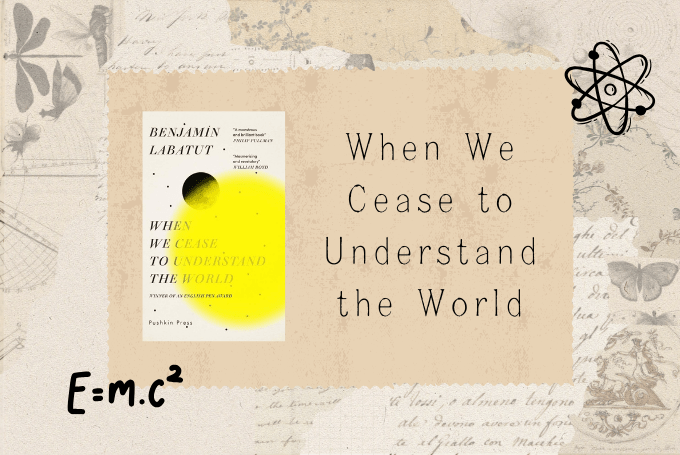
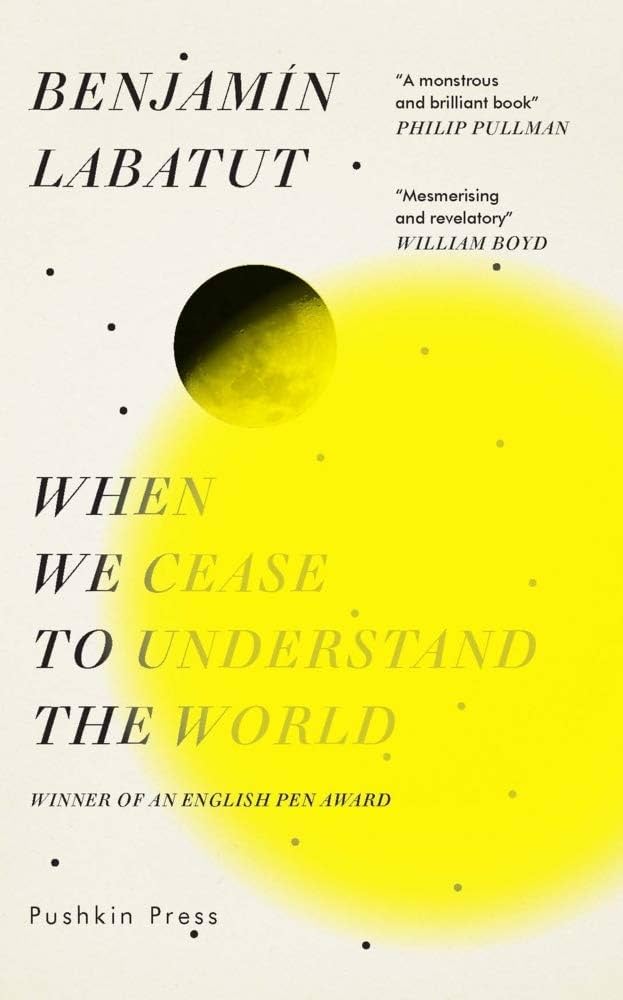
When We Cease to Understand the World by Benjamín Labatut
Translated by Adrian Nathan West
2020 | Chile | Lit Fic, Historical Fiction | Adult | 192 pages | ⭐
A series of stories about the descent into madness of great scientists of the 20th century, ranging from the completely factual to the completely fictional.
I can’t say this is the worst book I’ve reviewed on this blog, but it’s definitely the lowest rated, since I would’ve usually DNF’d a book if I wasn’t enjoying it as much as I didn’t enjoy this one. In fact, I only finished it because I was buddy reading it with a friend (and if it had been any longer, I probably still wouldn’t have).
The Not-so-Bad
The first part of this book was the best – and this is very evident, since this book consists of five short story/essay combinations. The first is most people’s favourite (even among people who enjoy the book), and I did like it, although I thought the point could have been clearer. It is also the most factual of all the essays/stories – it reads like an essay and is nonfiction apart from the final paragraph. I found the writing style of both the first and second short story engaging, the translation was well done, and the second story also had a more coherent structure.
Paedophilia
The titular story is everyone’s least favourite, at least among those reviews that are less than positive about the book, and perhaps one of the biggest reasons is the depiction of paedophilia. It’s graphic and weirdly eroticised and generally just all the things that I don’t think depictions of pedophilia should be in fiction. I wouldn’t say it’s necessarily romanticised, but the focus definitely isn’t on how harmful such an action is; it’s more just another aspect to the character. There is historical evidence for this particular scientist being a paedophile, but the actual story depicted here (as far as I can tell) is fictional, so it’s completely up to the author how to portray it, and I don’t think it was handled with sufficient caution and care.
Actually… it’s the whole thing
The paedophilia might the most widely controversial and repelling aspect of this book. However, it is not the book’s primary theme and is only present in one of the stories. My criticism of the book is far more overarching, however, and encompasses the two key selling points of the novel: the mix of fact and fiction, and the focus on scientists going mad in the pursuit of great science.
First, the mixing of fact and fiction.
On the surface level, I don’t mind this – after all, it’s just what historical fiction does. However, this book specifically states that it starts out factual and becomes increasingly fictional, but it’s never quite made clear which parts are factual and which are fictional. I did some reading on this, and the general consensus seems to be that the science is real and a lot of the facts about people’s lives are real, but the actual description of those events or what happened during long periods we don’t have records for is fictional.
I usually don’t have an issue with a bit of fiction and fact blending in something that is considered historical fiction, but since this is posited as somewhere between fact and fiction rather than just fiction, I found myself second guessing and trying to verify facts throughout the novel. This could make for an interesting discussion about fact vs fiction, misinformation etc. in the modern day, and I also think the increasing fictionality of the stories mirroring the descent into madness of the characters is an interesting parallel. However, I mostly found it distracting, and I am worried whether it is approached with enough criticality and intentionality, considering the prevalence of misinformation and disinformation in today’s society.
My biggest issue, however, is with the novel’s central theme of ‘great’ individuals who are pushed into madness as they encounter problems and make scientific discoveries (that, of course, the rest of the world are too dumb or sane to understand).
For one thing, it’s a wholly unoriginal idea – the concept of the ‘mad scientist’ or that a genius must always be somewhat mad is ancient, and sorely overdone. Reading some reviews by scientists, the general consensus (and one that I agree with) seems to be that these people represent a small minority and that the majority of scientific advancement comes through the collaboration and sustained effort of many (usually not high or insane) scientists. There is a variety of scientific literature on the topic of the ‘mad genius’ exploring where there is a connection between certain conditions, such as bipolar and schizophrenia, and what we colloquially consider ‘genius’ (such as heightened creativity or pattern recognition skills etc.), however, the research thus far is inconclusive.
I don’t necessarily think that a novel about scientists going mad can’t be done well – if I did, I wouldn’t have picked this book up, since it’s pretty clear that this is what it is about. However, I don’t enjoy the conclusion that Labatut draws from this. He takes this ‘inevitable’ madness in the face of understanding science, and the potential negative effects of scientific discoveries, as evidence that we ought to be careful about knowing too much or trying to discover too much. This is not only a pretty empty answer to the various moral questions posed by scientific advancement, given that it doesn’t even offer a viable alternative, but it also ignores much more interesting and nuanced takes. For instance, were these ‘mad’ scientists of the 20th century actually driven ‘mad’ by their ceasing to understand the world, or were they simply cases of untreated mental illness and social isolation leading to mental breakdowns, geniuses that were also human and were failed by society and medicine’s poor understanding of mental health at the time?
A final criticism is that all of the scientists covered here were white men. There were equally mad female scientists Labatut could have explored, or perhaps scientists of colour – although given the treatment of the scientists here, I’m almost glad he didn’t touch these people’s stories. However, it does make it seem like, to Labatut, all the scientific discoveries of the 20th century – for better or worse – were made by mad white men (the women in their lives are invariably nags or objects of erotic desire… or both).
Verdict
Overall, any enjoyment I had from the beginning of this novel (and I did learn some pretty interesting, if gruesome things, about the use of poison and drugs in World War II and the development of fertiliser) was eclipsed by the graphic pedophilia and general bland exploration of the novel’s central theme.

(Hey, at least I didn’t give it 0 or 0.5 stars!)
If you’re looking for more information about scientific discoveries of the 20th century, look for a nonfiction book (or one of I’m sure many other fictional books about the topic). Unfortunately, I haven’t read any myself so I can’t offer any reviews.
If you’re mostly intrigued by the themes, however, and want a book that explores the morality of scientific exploration and discovery in much more nuanced and productive ways, then I highly recommend To Be Taught, If Fortunate by Becky Chambers – you can read my review here.
This is a much more negative review than I normally post, but I was so frustrated by reading this book, and all the reviews I had previously seen were positive (I did discover many people who agree with me after reading this book and looking through the Storygraph reviews, but so many high profile reviews of this book treat it like the best thing since sliced bread).
I had intended to just include it in a mini review post like I do most of my DNF reviews, since I hate to spotlight negativity, but it ended up requiring far too much space to address the issues with even the bare amount of nuance that I felt they required, so it turned into this actually fair long review instead.
Oops!
I hope you enjoyed anyway, and do let me know how you felt about this book if you read it! If you enjoyed it, I’d also love to know why.
Keira x
![[Review] Daggerbound by T. Kingfisher](https://keirasbookmark.com/wp-content/uploads/2026/08/screenshot-2026-08-02-at-22.16.59.png?w=1200&h=900&crop=1)


 Keira's Bookmark