
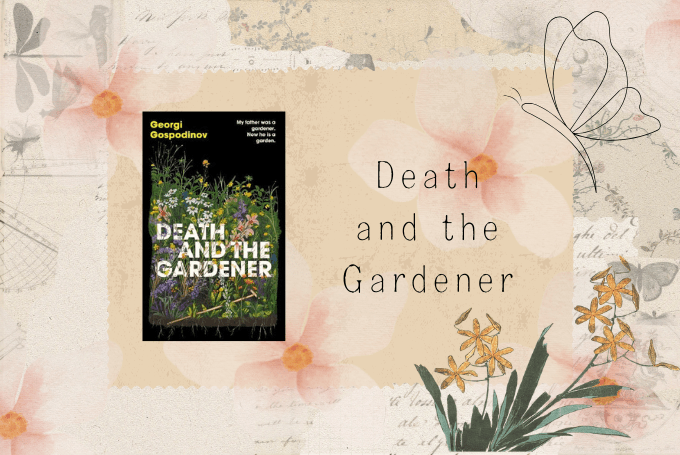
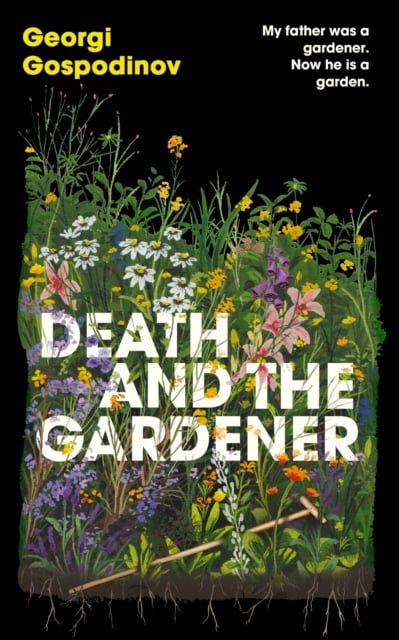
Death and the Gardener by Georgi Gospodinov
2024 [EN: 2025] | Literary Fiction | Bulgaria | 213 pages
My father was a gardener. Now he is a garden. A man sits by his father’s bedside and reports radically and gently until a final winter morning.
His father was one of that generation of tragic smokers born right after the World War II in Bulgaria. A rebel without a cause, he knew how to fail with heroic self-deprecation.The garden he created out of a barren village yard first saved him, then killed him. It remains his living legacy: peonies and potatoes, roses and cherry trees – and endless stories.
But without him, his son’s past, with all its afternoons, began to quietly crack. Because the end of our fathers is the end of a world.
The end of the world doesn’t come to each of us at the same time.
Death and the Gardener is a Bulgarian novel that blurs the boundaries between fiction and nonfiction to the extent that I had to look up whether it was a true story. The narrator’s voice is extremely strong, and since the narrator is a novelist writing a memoir about his experience of his father’s death, it genuinely reads like a (very compelling memoir). I can confirm it is fictional (mostly), but it is also largely based on the actual author’s recent experience of losing his own father, so the emotions at least are probably genuine – and you can tell.
Death is a cherry tree that ripens without you.
Books with garden settings or garden-related elements seem to be doing really well for me these past couple of years – The Enchanted April and The Garden of Evening Mists were two of my favourite reads of 2025, for example. This is no exception, although the way it incorporated gardening differs quite significantly from those two novels. Although Evening Mists does focus to some extent on the creation of the garden, the garden provides more of an atmosphere and setting in those two novels, whereas here the garden is a symbol of the father and is used more as a way of understanding the father through his work in the garden and coming to terms with his death.
God, as usual, didn’t seem to be listening, and his deputy here on earth, the doctor, didn’t dare make any promises either.
In general, the book is not wholly chronological nor does it make a complete narrative ‘arch’ in a traditional sense. Rather, the book follows the rather scattered process of our narrator coming to terms with first his father’s illness and then his death – interspersed by recollections of both his and his father’s childhood and other stories as the narrator reflects not only on the meaning of life and death but also on his relationship with his father and who his father was as a person. There are also some interesting cultural reflections on the cultural context that produced these relationships and specific characters.
To my mother and father, who are still weeding the eternal strawberry fields of childhood.
The writing throughout the novel is gorgeous and extremely quotable (as you can probably tell from how many quotes I have included in this review). Sometimes overly quotable writing feels didactic and insincere, but since this was written in a sort of journalling, reflective style, it didn’t feel like someone was trying to wax poetic whilst doing the dishes and therefore didn’t feel out of place in the slightest. The writing also remained accessible, and the translation is very idiomatic and does a good job of preserving and explaining certain linguistic features and discussions about the Bulgarian language.
Old age is getting used to a long, perhaps eternal, horizontality.
The only reason this gets 4.5 stars rather than a full 5 stars is that I was less emotionally devastated by it than I had expected. It made me think a lot, and I definitely had stinging eyes a couple of times (although perhaps not in the expected places), but despite being quite sensitive to stories surrounding parental death, etc. I didn’t feel a huge emotional impact – which may be for the better, since I might have been crying the whole way through otherwise. It felt more like a brain exercise than a heart exercise – but an exercise my brain very much enjoyed.

He knew quite a few poems by heart… He also knew by heart all the terrible poems I’d written as a child. I only realised this in his final years.
Buy this book!
I am very passionate about supporting authors, libraries, independent bookshops and generally any bookshop that isn’t Amazon! Therefore, I will always try and make it as easy as possible to buy books from sources that aren’t Amazon by providing links. Bookshop.org UK links are affiliate links that help support indie bookshops as well as myself without affecting the price you pay. Delivery is UK-only, but US-based customers can also check out Bookshop.org US. All other links offer international shipping, but please also consider supporting your local bookshop or library!
Have you read this book? If so, what did you think of it? If not, do you think it might be worth picking up?
Keira x
![[Review] If We Cannot Go at the Speed of Light](https://keirasbookmark.com/wp-content/uploads/2026/05/screenshot-2026-05-05-at-17.31.20.png?w=600&h=450&crop=1)
![[Review] Two Women Living Together by Kim Hana and Hwang Sunwoo](https://keirasbookmark.com/wp-content/uploads/2026/03/featured-image-size-39.png?w=600&h=450&crop=1)


 Keira's Bookmark