
I received a copy of this book courtesy of NetGalley and the publisher in exchange for an honest review. All opinions are my own.
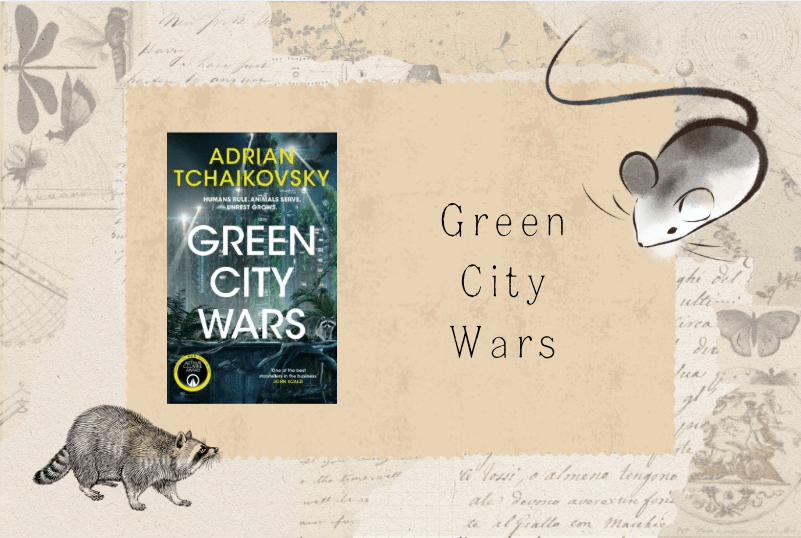
Green City Wars by Adrian Tchaikovsky
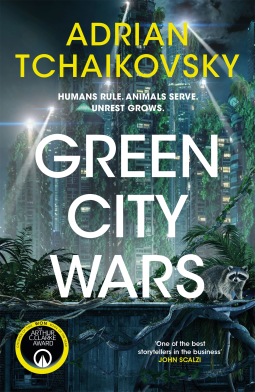
25th June 2026 | Science Fiction | UK | 368 pages
In a city of sunshine and secrets, the shadows belong to the animals.
In a solar-powered future, humans live in luxury, served by unseen Little Helpers – artificially enhanced animals who maintain their perfect green cities. The animals’ number one rule: ‘Do Not Bother the Humans’. Yet beneath this tranquil facade, a complex underworld of animal politics, crime and conflict thrives.
Enter Skotch, a freelance raccoon investigator. His biggest problem was a lack of work. Now his work may get him killed. And his latest case? Finding a fugitive mouse scientist. But powerful forces are also after the mouse, and they’re willing to kill for his secrets.
Can Skotch navigate this treacherous web, outsmart rat gangsters, beat a deadly weasel assassin and keep his pelt intact? More importantly, can he find his quarry before the elusive rodent breaks Rule One in the most apocalyptic way – and shatters their fragile world.
My previous experience with Adrian Tchaikovsky is limited to this The Final Architecture series, which I absolutely love, but unusually for Tchaikovsky, does not focus on animals. When I saw that this book was a standalone and featured animals in a major way without focusing on spiders, I thought it might be a good way to ease myself into his animal-focused books (spiders scare me, although I’m getting better about them).
I’m not so sure that was an accurate judgement – I didn’t like this nearly as much as The Final Architecture, and his space-based animal stories, like the famous Children of Time, might have been a better entry point.
However, if we’re judging this book not as a bridge from The Final Architecture to Tchaikovsky’s works but rather as an individual work, it definitely has a lot going for it (as well as a few major things holding it back – some personal to me and some more general).
Probably one of the strongest points of this book is the worldbuilding. Green City Wars is set in a futuristic Earth (specifically in a green city called ‘Neuwien’ or New Vienna). Green cities are environmentally sustainable cities where humans are guaranteed a basic standard of living. However, these cities run on a backbone of unseen Gehirner labour – Gehirners being animals that are genetically enhanced to have heightened intelligence and learning capabilities. In the hidden, shadowy parts of the cities, the Gehirner have developed a complex society with complex social and political rules, a developed economy and even warfare. This is the backdrop of our story, following a freelance investigator raccoon who is tasked with capturing a mouse scientist who promises to change Gehirner life forever.
The world is developed in a lot of detail – all of which is very interesting, and a lot of it offers food for thought and commentary on issues that we are currently facing, such as how to deal with environmental collapse and move beyond late stage capitalism and fossil fuels, whilst also focusing more on the unintended consequences of human experiments and technology when its removed from human oversight and creates a hidden society of its own.
Tchaikovsky’s ability to create characters who are intelligent animals with complex social behaviour and societies made in the image of humans without making them read like humans in animal bodies is particularly impressive – you really do get the impression that these are animals who have acquired additional brain space rather than human brains implanted in an animal body.
However, whilst the worldbuilding is definitely one of the story’s strong points, it also becomes one of its major weaknesses. Tchaikovsky gives us so much detail about the way Gehirner society and biology works and all of the different forces at play in the society that it at times becomes repetitive and slows the pace of the first half of the book down to a crawl. It also comes at the expense of developing other areas of the book, such as the relationships between the characters.
You spend a lot of time in Skotch’s head and get a good sense for who he is, and you do come to care about the fate of other characters as well. However, you don’t get as much time as I would like building the relationships between the characters, so their death or injury didn’t affect me as much emotionally as I would have hoped. Rather, I cared about what happened due to a desire to find out hidden information (he really keeps the reason everyone’s after the mouse a secret until the very end) and a sense of increasing tension that Tchaikovsky does a good job of creating in the second half of the book where the pacing really picks up.
That is the good news, though: if you can get through the slower first half of the book and just enjoy learning about the world, then the pacing picks up significantly in the second half of the book. If you take a look at my Storygraph reading record for this book, it took me 10 reading sessions across three weeks, with a maximum of 30 pages read at a time to get to 50%. I read the final 50% in a single day across three sessions (mostly because two of them happened during breaks at work). Of course, that’s also partially because I was running out of time to read the book before release, but it does feel reflective of the book’s pacing as well: a crawl to begin with, but much faster and more engaging towards the end.
The final thing I will say is that this book very much reads like a detective/crime procedural/noir novel set in a sci-fi setting, and as much as I enjoy watching crime procedurals, I don’t tend to enjoy them as much in book format. This was a similar issue that I had with The Tainted Cup by Robert Jackson Bennett, where I couldn’t enjoy it until the crime elements connected to broader political themes, and I think that was largely true for this book as well.
That being said, if you do like crime-based plots and especially if you’re interested in reading something slightly like The Tainted Cup but in a more sci-fi setting than a fantastical one (and with significantly less body horror), then I think you might really enjoy this book. It definitely has a sort of hard work and stubbornness > innate talent as a detective approach that reminds me more of Din from The Tainted Cup than someone like Sherlock Holmes.
On the other hand, if you can’t deal with animal death (at the hands of other animals, but still) then maybe stay away from this book.

Overall, I gave it 3.5 stars based on my personal enjoyment, but I think it could easily be a 4 star book for someone who is more into crime and detective novels. I do think it could have done with a map though.
Buy this book! It’s out today, so you won’t have to wait for your preorder to come in.
I am very passionate about supporting authors, libraries, independent bookshops and generally any bookshop that isn’t Amazon! Therefore, I will always try and make it as easy as possible to buy books from sources that aren’t Amazon by providing links. Bookshop.org UK links are affiliate links that help support indie bookshops as well as myself without affecting the price you pay. Delivery is UK-only, but US-based customers can also check out Bookshop.org US. All other links offer international shipping, but please also consider supporting your local bookshop or library!
Are you thinking of reading Green City Wars? If you’ve read any other Adrian Tchaikovsky books before, I’d also love to hear what your favourites are!
Keira x
![[Review] Daggerbound by T. Kingfisher](https://keirasbookmark.com/wp-content/uploads/2026/08/screenshot-2026-08-02-at-22.16.59.png?w=1200&h=900&crop=1)


 Keira's Bookmark