Hello!
Have you been seeing some funky loading bars in my posts?
Something a bit like this:

Or have you been seeing a lot of A1, B2, C1 etc. and feeling a little lost?
No worries! That’s what this page is for. First I’ll explain the CEFR system (that’s what all the A1, B2, C1 thingies are referring to) and how I map common language exams for my languages to it. Then I’ll explain the loading bars.
CEFR

This is my very brief summary graphic to explain the CEFR. This is probably most useful for the UK readers among you as it makes reference to GCSE and A-Level, but I’ll try to explain a bit more so that everyone can understand.
CEFR splits language ability into three categories:
A
A is for BASIC USERS. Also known as BEGINNER.
At A1 you can get by in very basic interactions. You can introduce yourself and others and ask simple questions about things like age, where someone lives etc.
A2 is enough to get by as a tourist without using English for basic interactions,. You can talk about most things immediately relevant to you in a basic way – your personal information, daily tasks such as shopping and your job, ordering food etc. So long as native speakers are patient and speak clearly, that is.
B
B is for INDEPENDENT USERS. Also known as INTERMEDIATE.
At B1 you can start having conversations with native speakers on topics specifically related to you – your life, your work, your hobbies, your dreams and goals. You can give simple opinions about things and deal with most situations when travelling (not just ordering food). Some people would consider this the beginning of being conversational.
The jump from B1 to B2, and the range of skills within B2 is huge. In fact, the CEFR categories get broader and broader as you go up. I also find this where people start having really asymmetric skills (e.g. you might be really good at reading, but suck at speaking).
Generally speaking, though, B2 learners can understand the main ideas (both concrete and abstract) of discussions, including technical topics in their area of expertise. They can have spontaneous and extended conversations with native speakers without much effort or strain, and can write clear, structured texts, although not without mistakes. Some people consider this the start of being fluent.
C
C is for PROFICIENT USERS. Also known as ADVANCED.
At C1 you understand a wide range of long, demanding texts, including implied meaning (so you can read and understand literary texts, for example). You can express yourself fluently and spontaneously, with a flexible and confident use of language suited for the occasion. You should be able to write complicated texts on complicated topics with a degree of confidence.
C2 is the level of a university-educated native speaker. Not even all native speakers have a C2 level. C2 requires synthesis of various sources, reconstruction and coherent presentation of complex ideas and the ability to spontaneously and fluently express oneself with precise degrees of nuance.
CEFR vs Other Systems
CEFR is a widely used system across Europe and probably because it can be easily applied to lots of languages, it is also super popular among language learners. It is so widely used that even standardised language exams in English and non-European languages that don’t natively use the CEFR system often offer equivalents. When these are official – printed on the certificate – they can be considered substantiated, but otherwise they are sometimes claims with little backing (and much controversy).
Here I will briefly show what I consider the equivalent of CEFR to be in the ACTFL levels (used in the US), as well as in the language level systems used in China, Taiwan, Korea and Japan (as the languages I am learning) – no need to do it for any of my other languages as they use the CEFR system directly.
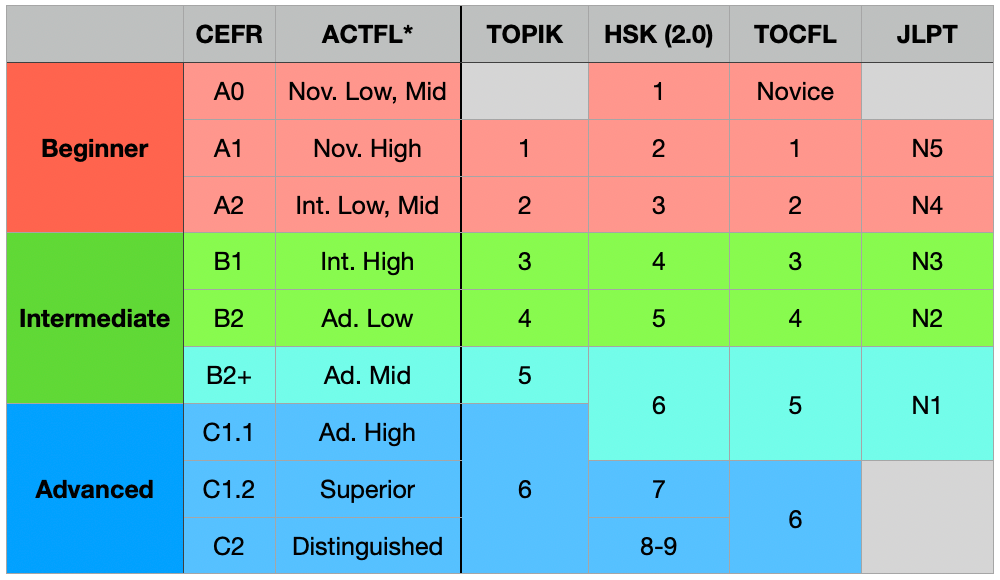
Sources and Explanation for Equivalencies Given
ACTFL (American Council for the Teaching of Foreign Languages) standard
- Source: Assigning CEFR Ratings to ACTFL Assessments (ACTFL 2016)
- Note that they assign different equivalency levels for receptive/productive skills and I have given an average in the table above.
Official Equivalency Table:

TOPIK (Test of Proficiency in Korean)
The official claim is that there is a 1:1 match between TOPIK levels 1-6 and CEFR A2-C1 (National Institute for International Education, 2024). However, no equivalency is given on the exam certificate (which would require a detailed research and standard-setting agreement) and there is no source given on the documentation making this claim.
Independent research by Korea-based researchers also claim a 1:1 equivalency between the levels (Kim Chungsook et al. 2025 – the text is in Korean, but there is an English abstract). However, they do also note some key weaknesses of the test:
- There is no compulsory spoken section (a separate spoken exam is now available in some countries, but this is a computer-based test without any in-person interaction).
- The reading/listening sections are entirely multiple-choice and the number of questions and length of said questions is limited, especially as it has to cover 4 levels in 50 questions, in the case of the TOPIK II (Intermediate-Advanced) exam. This limits the rigour with which the test is able to test the upper levels.
- They note that Level 4 is a slightly lower level than B2 (although they later claim equivalency because there is much overlap). I have the power to give a more detailed equivalency, which is why I have split B2 into B2 and B2+ to show this distinction.
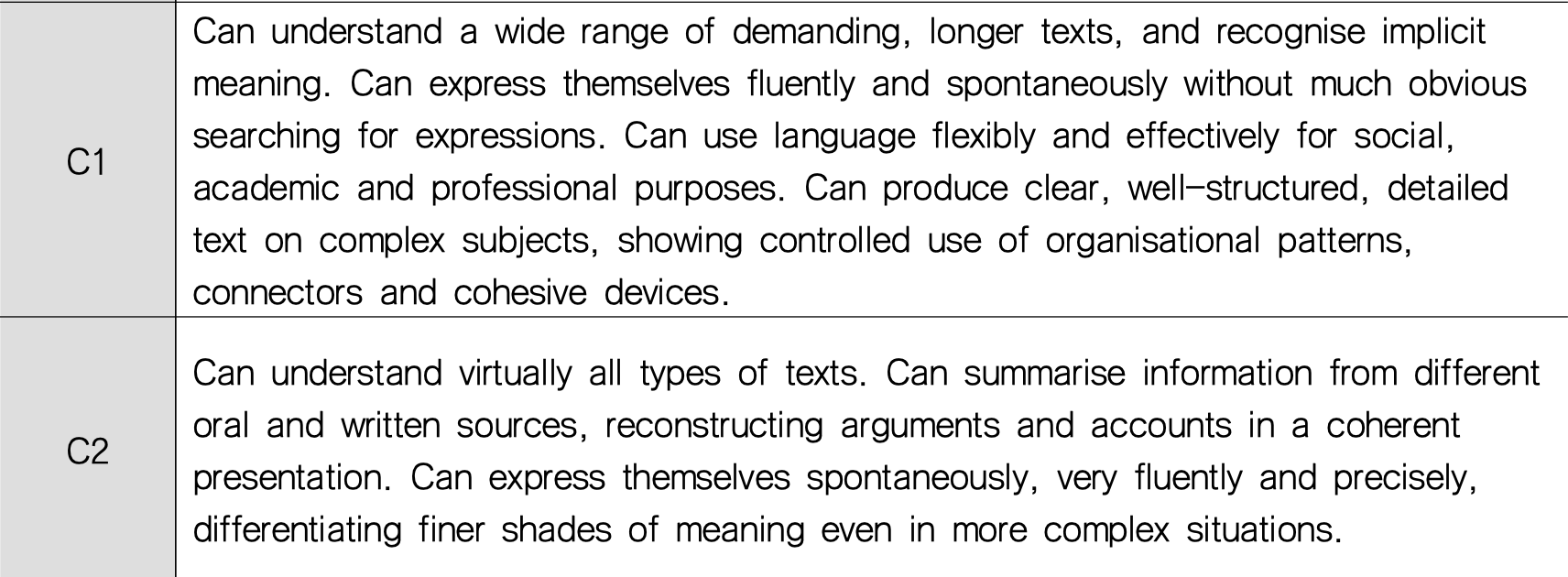
- They focus on similarities between level descriptors at the higher levels, but don’t note the differences, of which there are some significant ones. Note in the pictures below that level 6 still uses qualifiers such as “most”, where as C2 does not. This doesn’t mean there is no overlap, but I would argue Level 6 starts from a lower point than C2.

Finally, there is my personal experience. I haven taken the TOPIK exam twice and got a level 6 both times. However, despite achieving an extremely high TOPIK grade initially, when I went to Korea after taking it the first time I was placed in a Level 5 class (so I should have achieved a level 4 on the test, by that logic, as I was yet to acquire level 5 skills). This highlights where the test can fail at testing the skills each level requires. That being said, I found the reading and listening sections difficult the first time I took the test and made a lot of guesses.
The second time I took the test, two years later, having graduated level 6 of a Korean language programme in Korea, attended university classes in Korean and worked as a translator for over a year (so my Korean was definitely better), I got a higher score on reading but a lower score on writing. This is partially luck, partially a lack of preparation – I prepared a lot for the first test and not at all for the second.
What I can say, is that I would self assess by Korean at the time of 2023 exam as a C1 (and B2 at the time of the 2021 exam) based on my experience with German, and I found the reading/listening section easy(ish) in 2023 – I didn’t have to guess 99.9% of the time. Therefore, I would be happy saying that level 6 can test C1 if you’re answering because you actually know the answer, rather than just having good exam technique (which will always be the shortcoming of multiple choice tests like this).


Also, not to brag, but my exam technique is quite good so these results are probably skewed slightly and not representative 100% of the average test taker. And as you can see I could still get more points, especially in writing. That being said, my general feeling about Level 6 = C1 seems to be echoed by other learners as well, who are even harsher and say Level 6 = B2 (which I would agree with at the lower end of level 6) (see this reddit thread).
Therefore, I think that Level 6 can test and encompass C2, but I think it encompasses C1 as well: it is the upper band, it is everything from C1 and up. Level 5 is probably closer to that upper B2, maybe the very bottom of C1 – the bit that of B2 that is missing from Level 4, as per the researcher’s conclusions. I’m obviously not a professional and this is largely anecdotal, which is why I have also included the research above, but as this is about the equivalencies I use personally, I will make Level 5 = B2+ and Level 6 = C1 and up.
HSK (Hanyu Shuiping Kaoshi – China’s official Chinese test)
Hanban, a Chinese government organisation who run the HSK, and the Confucius Institute (who used to be under their leadership but is now technically separate) claim that the HSK 1-6 is equivalent to CEFR A1-C2. This has been thoroughly debunked by every other standards assessing organisation and individual researcher who has cared to research it. For instance, the German Association for Chinese Language Teachers suggests the following equivalencies instead:

Although Hanban haven’t announced that this is wrong, it seems they acknowledge it to as they are now preparing to move from HSK 2.0 to HSK 3.0. Looking at the differences between the two will a) help future proof this page a bit and b) show where the current HSK falls short.

Source: DigMandarin.com
It looks like levels 7-9 will correspond to C1 and C2 (and this is was likely possible under HSK 1.0 which was also harder). In terms of the others – HSK6 will be almost the same level in HSK 3.0 as it is in 2.0, so I would suggest that the highest level won’t change. However, it is clear that the requirements at other levels have become much stricter – this will mean a more gradual progression than the current HSK, but also a bigger base of knowledge needed to pass the lower level exams. If we look at the current HSK – CEFR equivalencies offered by FaCh, then the new HSK 3.0 equivalency could look something like this (of course the exact equivalencies will have to wait until it’s officially released and professionals look at it).
| HSK 2.0 | HSK 3.0 | CEFR |
|---|---|---|
| 1 | ||
| 2 | ||
| 3 | 1 | A1 |
| 4 | 2/3 | A2 |
| 5 | 3/4 | B1 |
| 6 | 5/6 | B2 |
| 7-9 | C1-C2 |
I will say, I took HSK4 and then tested into a B1 class, so I think the German Association might have been a tiny bit harsh, but certainly not by much. I would also say that the HSK does have a compulsory writing section that requires summarisation, which is quite tricky and therefore can probably test a very high B2. Some suggest it touches on the bottom end of C1. For now, until HSK 3.0 is out I will display it as such.
Please do note that HSK 3.0 7-9 exams have already started, but it hasn’t been rolled out to lower levels yet, which is why the table I included above says HSK 2.0 but includes HSK 3.0’s 7-9 levels.
TOCFL (Taiwan’s official Chinese test)
TOCFL offers CEFR equivalencies on their official website which are also printed on the official certificates, and they claim to be based on a series of research carried out in the 2010s. Separate equivalencies are published for each of the four skills (reading, listening, writing, speaking) and each test type.
The most commonly taken TOCFL exam at the moment is the Computerised Adaptive Testing (CAT) test, which tests only listening and reading. These find an equivalency between TOCFL Levels 1-6 and CEFR A1-C2. A similar equivalency is also found in other skills and test types, but it is important to note that it is completely possible to pass the CAT at a C1 level but have lower levels in other skills.

Additionally, the CAT exam is also multiple choice. Although it doesn’t have the issue with limited question number and length like TOPIK as questions are adjusted for the individual learner’s level, it is still possible to “guess” the correct answer. Nevertheless, allowing for this, the actual skill level of the content provided to test each level of the TOCFL seems to be equivalent to CEFR.
JLPT (Japanese Language Proficiency Test)
Official equivalencies for CEFR are given on JLPT exams, however it should be noted that these are valid for receptive skills only as the JLPT does not test productive skills. It is useful to note that the JLPT only claim equivalency up to level C1, not C2. More details (in English) can be found on the JLPT website, where the table below also comes from. The PDF detailing the research is in Japanese only and my Japanese isn’t good enough to read it. I’ve also never taken the JLPT so I have nothing else to add here!

My Progress Bars
Now that you know what the CEFR is, let’s have a look at how I use it to display my language progress in my posts.
In my posts you might see graphics that look something like this:
Each of the vertical lines in the loading bar represents a new CEFR level with the first being A1, then A2, then B1, B2 and C1. The two ends of the chart represent nothing (pre A1) and C2, the highest possible level. The more purple rectangles the are, the higher my level, and the darker the purple the more solidified said level is.
So taking the example from above:
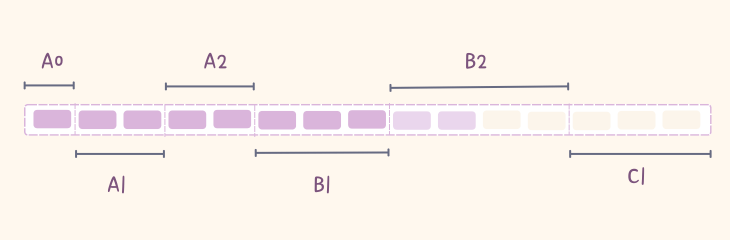
- My pre-A1 to B1 squares are all dark purple – they’re pretty solid.
- I’ve got two light purple squares in B2 – this is where I’m working at the moment, but this level isn’t solidified yet.
- The cream squares represent stuff that is still beyond my level.
This would translate into a low/mid B2 level. Hopefully that makes sense!
Bibliography
CEFR
- Council for Europe. “Global scale – Table 1 (CEFR 3.3): Common Reference levels”, Common European Framework of Reference for Languages (CEFR). Accessed 11 July 2025. https://www.coe.int/en/web/common-european-framework-reference-languages/table-1-cefr-3.3-common-reference-levels-global-scale.
ACTFL
- American Council for Teaching Foreign Languages. “Assigning CEFR Ratings to ACTFL Assessments”. Accessed 11 July 2025. https://www.actfl.org/assessments/assigning-cefr-ratings-to-actfl-assessments.
TOPIK Exam
- Comments in response to: DirichletProduct. “How do TOPIK levels compare to the CEFR?” Reddit. 2023. Accessed 11 July 2025. https://www.reddit.com/r/Korean/comments/16ohjde/how_do_topik_levels_compare_to_the_cefr/.
- Kim Chungsook, Lee Junho, and Lee Jung Hee. “한국어능력시험(TOPIK)과 유럽공통참조기준(CEFR)의 등급 기술 비교·연계 연구 [A Study on an Analysis and Comparison of the Level Descriptors of the Test of Proficiency in Korean (TOPIK) and the Common European Framework of Reference for Languages (CEFR)]”, Korean Education 36, no. 1 (2025): 109-138. DOI : 10.18209/iakle.2025.36.1.109.
- National Institute for International Education.”한국어능력시험(TOPIK) 유럽공통참조기준(CEFR) 연계표 및 등급기술문 [Test of Proficiency in Korean (TOPIK) and CEFR Equivalency Table and Grade Skills Descriptions]“. Published Materials, 2024. Accessed 11 July 2025. http://www.niied.go.kr/user/nd60543.do?View&boardNo=00010548#attachdown.
- Won, Yunhee. “Common European Framework of Reference for Language (CEFR) and Test of Proficiency in Korean (TOPIK)”, International Journal of Area Studies 11, no. 1 (2016). DOI:10.1515/ijas-2016-0003.
HSK
- Confucius Institute Maastricht. “Introduction to HSK Courses”. Accessed 11 July 2025. https://www.confuciusmaastricht.nl/en/hsk-courses-and-exam-information.
- Fachverband Chinesisch. “Sprachprüfungen [Language Exams]”. Accessed 11 July 2025. https://www.fachverband-chinesisch.de/chinesisch-als-fremdsprache/sprachpruefungen/
- Dig Mandarin. “The New HSK (2025): An Overview and What’s Changed”. Last updated 6 January, 2025. https://www.digmandarin.com/new-hsk.html.
TOCFL
- Steering Committee for the Test Of Proficiency – Huayu. “CEFR & ACTFL & TBCL” Computerized Adaptive Testing Conversion. TOCFL. Accessed 11 July 2025. https://tocfl.edu.tw/tocfl/index.php/test/cat/list/4.
- Steering Committee for the Test Of Proficiency – Huayu. “CEFR & ACTFL & TBCL” Writing Conversion. TOCFL. Accessed 11 July 2025. https://tocfl.edu.tw/tocfl/index.php/test/cat/list/4. https://tocfl.edu.tw/tocfl/index.php/test/writing/list/9
- Steering Committee for the Test Of Proficiency – Huayu. “CEFR & ACTFL & TBCL” Writing Conversion. TOCFL. Accessed 11 July 2025. https://tocfl.edu.tw/tocfl/index.php/test/speaking/list/8
JLPT
- The Japan Foundation. “Indication of the CEFR Level for Reference”. Japanese-Language Proficiency Test. Accessed 11 July 2025. https://www.jlpt.jp/e/about/cefr_reference.html.
 Keira's Bookmark