
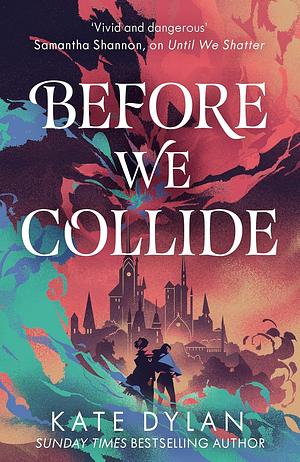
Before We Collide by Kate Dylan
2025 (Paperback coming 7th May) | Fantasy | England | 320 pages
Raya Wryvern, daughter of two powerful Shades who can read the future, was supposed to be a prodigy. Faced instead with the prospect of failing to graduate and having her magic bound, she goes against everything she’s been taught to ask the future an open question. It shows her the end of all magic and Ezzo, the boy she is destined to love. Except Ezzo is a half-Shade battling grief after the death of his lover (his weapon of choice is alcohol) and his existence is illegal.
I received an ARC of this book courtesy of Hodderscape and Negalley in exchange for an honest review. All opinions are my own.
I have a lot to say about this book – I was writing my thoughts down on some receipt paper whilst we were quiet at work but I was stuck on the till, and I find that doing that often means I end up with a really long review to write! I’ve tried to split it into a couple of subsections to make it easier to read. Without further ado, let’s ago!
Worldbuilding
I want to start off this review with the thing that probably kept me reading and made me give it three stars overall: the magic system. The rest of the worldbuilding is somewhat lacklustre, but I did find the magic system very interesting. In fact, the magic system and the external plot were interesting enough to keep me reading despite some issues I had with the characters and romance that I’ll talk about later.
It’s a magic system based on colour, where each magical person is associated with a specific colour that offers them certain powers, and where there is a semi-separate realm (the Gray) only accessible by magic people. I don’t think this is a new idea by any means, but I do like a slightly harder magic system and it kept my attention. There were some unexplained bits of the magic that made it feel like there was a lack of consistent internal logic in some places (i.e. why can Hues interact with their clothes and walk up stairs/on floors, but not open a door whilst in the Gray), but I think some of this might be explained more in the first book.
That’s right! I found out after reading this book that this is an unofficial sequel to the book Until We Shatter. I say “unofficial” because it is not listed as being part of a series, except that Ezzo was a side character in Until We Shatter, and the main characters from that book become side characters in this book. It also takes place after the events of Until We Shatter… so yes, this is a sequel. It’s a companion novel, to be sure, and you don’t have to read Until We Shatter first, but there is a decent amount of character and worldbuilding introduction stuff that I assume gains a lot of depth if you read Until We Shatter first (based on other people’s reviews, since I haven’t actually read that book). Just a heads up.
Writing Style
The magic system, as well as the quick pace of the plot, also kept me reading past the first few pages despite initially being put off by the writing style: first person present tense (which I don’t necessarily hate, but it will definitely make me pay attention to how you’re writing) combined with an overabundance of sentence fragments and brief sentences and a lot of explicit stating of emotions. The explicit stating of emotions was annoying because they would often be shown and then stated again just in case you hadn’t picked up on what was being communicated. This made the book read much younger than the adult book it’s being marketed as, and it was extremely distracting.
It gets toned down a bit as the story goes on (certainly not quite so many sentence fragments) and once I got used to it, I sort of tuned out the writing style and just read the content, which shows that there were no glaring errors to keep bringing my attention back to the writing, but it’s definitely not a writing style I prefer or think suits the supposed target audience. I think it reads a little Shatter Me-esque, though, so if you like that sort of thing, you might like this.
Characters
I feel fairly lukewarm about our main characters. Our FMC Raya is selfish and very prejudiced but she’s not completely irritating. The MMC Ezzo is less annoying, but I perhaps less developed because of an assumption that you will be attached to his story already from the previous book, despite this not being listed as an official sequel. In general, the cast of side characters is pretty good and I cared about them on a basic level, but I think it’s just impossible to develop any kind of depth with such a big core cast (six characters not including minor side characters or antagonists) in such a short book. Again, some of these characters show up in Until We Collide, so that might help a bit if you read that one first.
I mentioned Raya being selfish and prejudiced and quite a few of the characters are like this at the beginning – unfortunately, Raya being our POV character for a good chunk of the book made me find this quite irritating. The reason I say she isn’t completely irritating is threefold:
- Firstly (and perhaps most importantly), this characterisation is consistent with the worldbuilding and character background she has been given. Part of the point of this book is to show how effective propaganda, censorship and institution-led disinformation can be and Raya has very much drunk the hundreds-of-years-old Kool-aid, so to speak. Therefore, Raya’s blindness and horrific acceptance of discrimination and even violent discrimination support this message, even if she’s not the type of protagonist I personally prefer to read from.
- She’s supposed to be a young adult (19 or so) and I do think she reads a little naive for 19, but she also is comes from a sheltered and privileged background so I think her tendency to remark on issues other people face with a sense of detachment and her lack of critical thinking probably make sense for the character setup we’re working with.
- She does show character growth and we’re not stuck in her denial of the corrupt system for the entire book (yay!).
Character Growth, Relationships and Pacing
Speaking of character growth, this takes me to perhaps my biggest issue with the book: the pacing. Specifically, how the pacing affects said character growth as well as the growth of relationships in the story. This section includes mild spoilers that I think are likely self-evident due to the type of story this is. However, if you want to avoid all spoilers, please skip the section below and keep reading from where the writing returns to normal size (“TLDR:”).
The events of this book take place in the span of about a week. That’s just not realistic for what happens – not in terms of plot events, as I think it probably is possible for the actual physical events to happen – but in terms of emotional events. If it were so easy for someone to go from genuinely believing the propaganda against a group and being supportive of killing them to being at the front of the resistance and in love with one of these people they have been taught to hate with very little cognitive dissonance within the space of the week then… the world would be a very different place, I fear. Not that a sudden event can’t massively cause a shift in how you view a group of people – and not that Raya doesn’t experience any kind of conflicted emotion – but I just think it is shown to be far too easy. On the other hand, Akari’s initial reaction tracks as fairly expected, but she then does a compete 180 just because someone she love has a different opinion and I again find this unrealistic. I think both of these situations somewhat undermine the message about the veracity of propaganda and censorship. I’m not saying I would find the book more enjoyable if it took them longer to unlearn their prejudices and if they experienced more cognitive dissonance (since this is not the type of character POV I enjoy), but I do think it would have made for an objectively more solid book in terms of theme and pacing.
On a similar note, some reviews talk about enjoying Ezzo’s attempts to deal with his guilt and grief and decision to move on and I actually found this equally rushed and shallow. Going from broken-hearted, borderline suicidal with grief to kissing someone who disagreed fundamentally with your existence when you first met in the space of a week doesn’t work for me on so many levels, but especially, this quick turnaround just because he met ‘the one’ that cheapens the raw experience of grief. In fact, the romance in general is extremely lacklustre in this novel. I’m demisexual/romantic myself, so I know I’m slightly biased here. Still, I can enjoy a less-than-slowburn, but this was more in the ream of fated mates, where it’s not quite instalove, but it feels like the only reason the characters are together is that fate tells them they should be. Deciding that you don’t hate someone and that you can work together to achieve a specific end and being impressed by their actions does not a romance make, and I just wasn’t buying it here – partially because there was so little page time dedicated to actually developing a romantic relationship. Don’t go into this expecting romantasy – it’s a fantasy romance or a fantasy with a romantic subplot – but it does tick some romantasy trope boxes that I’m not a huge fan of, e.g. forbidden love, enemies-to-lovers, etc., all within the space of a week!
TLDR: The events of this book take place in about the space of a week, which is an absolutely unrealistic timeframe for the level of character growth and change in fundamental beliefs about the world that takes place here. It also means that the development of the romance is extremely weak. Some people enjoy how this book deals with moving on from grief, but I personally found it quite rushed and felt no connection to the romance at all. If you like forbidden love with a fated mates-adjacent romantic development (but don’t mind this being very subsidiary to the main plot) you might like this, but it very much wasn’t for me. The brevity of this timeframe undermined the strength of the message regarding propaganda, in my opinion, and I enjoyed almost every aspect of this story more than I enjoyed the romance.
In conclusion, this book suffers from a compressed timeline that is not conducive to the internal journey or romantic developments that Dylan tries to show, but the external plot and the worldbuilding are entertaining. I will say that this is being marketed as adult, but if you Google the author, it says she writes YA/Adult crossover books, and her previous series was marketed as YA. I think this should be marketed as YA too. The characters are very young adults who could easily be the protagonists of an upper-YA story. The writing, romance and just general complexity also very much read like a YA fantasy dystopia. And unlike Arcana Academy, which I also thought read more YA (see my review/rant here), there isn’t even any graphic content that would need redacting!
If the publisher wants to market this as adult to grab the adult audience, then I think it needs to be clearly marketed as YA/Adult crossover, since I do think it would appeal to fans of that niche, but for me, I just felt like I was reading a YA novel when I had thought I was reading an adult novel. I ended up adjusting my expectations halfway through and enjoyed it more, but I do think that inappropriate targeting of books like this can make people enjoy them less. Not because YA is somehow worse than Adult, but because readers go into the book with different expectations – just like it’s annoying if something says it’s a cosy crime novel but turns out to be more of a thriller. Not because a thriller is worse, but because that’s not what the reader was wanting.

Overall, I gave this book 3 stars. If it were an adult novel it might be 2.5, but I decided to read it as a crossover book, since that is generally what the author is considered to write, even if the marketing material for this book didn’t make that clear. Still, I was engaged from about 10% in to the end, and it was easy to read and entertaining. It also touched on some important themes and had an interesting magic system that kept my attention throughout.
Buy this book!
I am very passionate about supporting authors, libraries, independent bookshops and generally any bookshop that isn’t Amazon! Therefore, I will always try and make it as easy as possible to buy books from sources that aren’t Amazon by providing links. Bookshop.org UK links are affiliate links that help support indie bookshops as well as myself without affecting the price you pay. Delivery is UK-only, but US-based customers can also check out Bookshop.org US. All other links offer international shipping, but please also consider supporting your local bookshop or library!
Bookshop.org UK | Bookshop.org UK (ebook) | Blackwell’s
Have you read this book? What do you think?
How much do you think correct marketing of a book affects how much readers like it?
![[Review] Arcana Academy by Elise Kova](https://keirasbookmark.com/wp-content/uploads/2025/08/screenshot-2025-08-13-at-06.56.54.png?w=800&h=600&crop=1)
![[Review] The Everlasting by Alix E Harrow](https://keirasbookmark.com/wp-content/uploads/2026/02/featured-image-size-17.png?w=600&h=450&crop=1)
![[Review] The Second Death of Locke](https://keirasbookmark.com/wp-content/uploads/2025/10/screenshot-2025-10-31-at-10.24.07.png?w=600&h=450&crop=1)

 Keira's Bookmark